
Replacement Health Certificates: When are they permitted?
1 September 2026
Suffolk Coastal Port Health Authority (SCPHA) has recently received a number of enquiries about the use of replacement Health Certificates (HCs) for consignments presented at Border Control Posts.
In several cases, traders have asked whether a replacement certificate can be issued to correct errors identified after a consignment has arrived in Great Britain. While we understand the commercial impact of documentary errors, SCPHA must apply the legislation as written and cannot approve replacement certificates where the law does not permit them.
This article explains when replacement certificates may be accepted and when they cannot.
Why are Health Certificates important?
Health Certificates are official documents issued by the competent authority in the exporting country as per the requirements of:
They provide official assurances regarding:
-
Animal health requirements.
-
Public health requirements.
-
The identity of the commodities being imported.
-
The traceability of the consignment.
-
The country and establishment of origin.
-
The quantities and descriptions of the products being certified.
Border Control Posts and GB authorities rely on these certificates to verify that imported products meet Great Britain's import requirements.
Official certification is a process between competent authorities. The accuracy of the certified information is therefore fundamental to the integrity of the import control system.
What does the Legislation say?
Article 5 of Commission Delegated Regulation (EU) 2019/628 allows replacement certificates in limited circumstances.
A replacement certificate may be issued where:
-
The original certificate contains an administrative error; or
-
The original certificate has been lost or damaged.
However, the legislation also establishes an important limitation:
A replacement certificate must not modify information concerning the identification, traceability, or health guarantees of the consignment.
This restriction is critical and often misunderstood.
The legislation further explains that replacement certificates are intended for obvious administrative mistakes such as:
-
Minor errors involving transposed container numbers.
-
Transposed seal numbers.
-
Minor spelling errors, for example in addresses.
-
Minor errors in product descriptions.
Recital 8 of the Regulation (EU) 2019/628 : “To avoid misuse and abuse, it is important to define the cases where a replacement certificate may be issued and the requirements that need to be met by such certificates. In particular, these cases should be limited to obvious administrative errors, such as transposed numbers in the container number or seal number, spelling errors in addresses or in product descriptions.”
The purpose of these restrictions is to prevent misuse of replacement certificates and to preserve confidence in official certification.
In summary, replacement Health Certificates may only be considered in limited circumstances, such as obvious administrative errors or where the original certificate has been lost or damaged. They cannot be used to change information that affects the identification, traceability or health guarantees of a consignment.
When can a replacement certificate be accepted?
Examples of situations where a replacement certificate may be acceptable include:
Example 1: container number error
Certificate states:
ABCU1234567 or ABUC1234576
Actual container number:
ABCU1234576
The consignment itself has not changed and its identity remains the same.
A replacement certificate may be considered if the full identity and physical checks are satisfactory, and SCPHA is able to identify that this is the same consignment as certified by the exporting official veterinarian.
Example 2: Minor spelling error in the product name, consignee or consignor. Please note that spelling errors in establishment details are not acceptable for a replacement HC.
Certificate states:
"Felixstow"
Correct address:
"Felixstowe"
The correction does not affect the identity, traceability or health guarantees of the consignment.
A replacement certificate may be considered.
Example 3: Damaged certificate
The original certificate is damaged during transport but all certified information remains unchanged.
A replacement certificate may be considered.
When Can a Replacement Certificate NOT Be Accepted?
A replacement certificate cannot be accepted where the correction would change information used to identify or trace the consignment. This includes errors in the following parts of the HC:
-
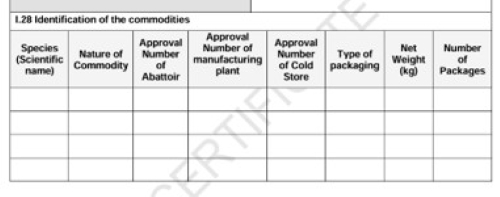
I.28 Identification of the commodities- HC under Commission Decision 2007/240/EC
For example all the information in this box:
-
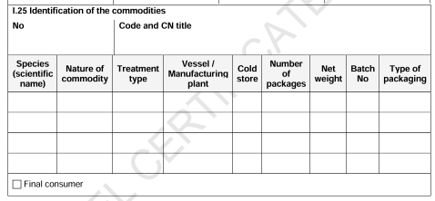
I.25 Identification of the commodities HC under Regulation (EU) 2019/628
For example all the information in this box:
-
All attached pages to the HC that relate to the identification and traceability of the commodities.
-
Part II. Certification
-
Country of origin
-
Region of origin
-
Place of origin
-
Temperature of products
-
Quantity, Number of packages, Total number of packages, Total net weight, Total gross weight, Type of packaging
-
Missing pages from the HC.
-
HC issued on a model that is not the required GB model: https://www.gov.uk/government/collections/health-certificates-for-animal-and-animal-product-imports-to-great-britain#products-of-animal-origin
In all of the above cases, Port Health will not allow a replacement HC because GB legislation does not permit this.
Examples are provided below. Please note that these are examples only and do not represent a complete list of all possible scenarios.
Changes to Product Quantities
Where a certificate states that a batch contains a specific quantity, weight or number of units, but the actual goods contain a different quantity.
Changes to Batch or Lot Information
Where the amendment would alter the certified batch information used to identify products.
Changes Affecting Traceability
Where the amendment would result in a different quantity of product being associated with a batch, production date or certified product entry.
Changes Affecting Identification
Where the information presented at the Border Control Post can no longer be matched to what was officially certified.
In these circumstances, the correction is not simply correcting an administrative error. It changes the information by which the consignment is identified and traced, and it may affect the health guarantees of the consignment.
Why do identification, traceability and health guarantees matter?
Some traders have argued that products remain traceable because they possess internal commercial records or batch systems.
Whilst commercial traceability systems are important, Border Control Posts must assess compliance based on the official certification accompanying the consignment.
The law requires that the health certificate accurately identifies the products being imported.
If product quantities, weights or other identifying particulars certified by the exporting authority are incorrect, replacing those details after arrival may fundamentally alter the certified identity of the consignment.
This is why legislation restricts the circumstances in which replacement certificates can be used.
Common Misunderstanding: "The Total Weight Is Correct"
A common argument is that the overall consignment weight remains correct and that only individual product entries need amendment.
However, official controls assess the identity of individual certified product entries, not merely the total weight of the shipment.
Where individual entries, batch details or certified product quantities differ from what is presented for import, correcting those entries would alter the information originally certified by the exporting authority.
In such circumstances, a replacement certificate will not be legally permissible.
SCPHA's Legal Responsibility
SCPHA understands that documentary errors can result in significant costs and delays for traders.
However, Border Control Posts do not have discretion to disregard legislative requirements or approve non-compliant documentation because doing so would undermine the integrity of official certification and the import control framework.
Our officers must apply the legislation consistently and fairly to all traders.
Where a replacement certificate is not legally permissible, the available outcomes will depend on the circumstances of the case and may include:
-
Re-dispatch to the country of origin.
-
Export to another destination.
-
Destruction of the goods where required by legislation.
Advice for trade
To avoid delays and enforcement action, SCPHA strongly recommends that:
-
Health Certificates are carefully checked by the certifying exporting authorities.
-
Product descriptions match the products loaded.
-
Batch details are verified.
-
Weights and quantities are double checked.
-
Seal and container numbers are verified before dispatch.
-
Importers contact their certifying authority immediately if a discrepancy is identified before arrival.
Early detection of errors will often provide more options than discovering issues after the consignment has arrived at a Border Control Post.
Further Information